
Detecting welding defects directly during production is a key lever for improving industrial performance and reducing non-quality costs. Drawing on several collaborative R&D projects with industrial partners, Cetim has developed dedicated software for the acquisition and analysis of data from multiple non-destructive testing technologies embedded directly in the welding process. These developments pave the way for online weld monitoring and the automation of quality control during manufacturing.
The Challenge: Improving Weld Quality While Boosting Productivity
In an increasingly demanding regulatory environment, companies in boiler making and piping must improve the efficiency of their inspection processes without slowing down production. Traditional non-destructive testing (NDT) methods – such as penetrant testing, magnetic particle inspection, radiography, or ultrasonics – are typically performed between passes or after welding is complete. When non-conformities are detected, repairs are often costly and time-consuming. Real-time, in-process monitoring would allow defects to be detected as soon as they occur, significantly reducing rework and contributing to faster process optimization.
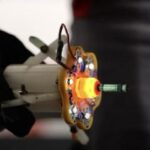
Instrumentation combining infrared thermography and phased-array ultrasonics for a MAG welding application, featuring a partially penetrated fillet weld on carbon steel.
Infrared Thermography Embedded in the Welding Process
Within the Factory Lab industrial consortium, and in partnership with manufacturers, Cetim led several projects, including Optim Soudage and Qualisoud, to evaluate passive infrared thermography for online weld inspection. The solution developed for those applications is based on an infrared camera (long-wave or mid-wave, depending on the application) mounted directly on the welding torch. This setup enables real-time observation of:
- the molten pool,
- the solidification zone, or
- the first centimeters of the cooling weld bead.
Connected to a data acquisition system, the camera provides live thermograms and thermal profiles, thereby generating data that can be used for automated defect detection. To ensure clear visualization of the recorded scene, the developers had to overcome a major technological barrier: detector saturation caused by arc radiation. This was achieved through a rigorous selection of wavelength passbands and the use of filters specifically adapted to the welding environment.
Proven Detection Capabilities
Extensive validation using conventional NDT methods has demonstrated the effectiveness of the system. A wide range of defects can be detected in real time, including:
- lack of fusion,
- hot cracking,
- porosity,
- graphite or oxide inclusions,
- and, depending on the application, subsurface defects such as lack of penetration.
Defects can be identified either directly in the molten pool or during the first stages of weld cooling, enabling much earlier corrective action.
Multimodal Approaches for Enhanced Monitoring
Building on these results, Cetim has explored complementary inspection technologies, used individually or in combination with thermography:
- Acoustic emission on WAAM-MAG (Wire Arc Additive Manufacturing),
- Phased-array ultrasonics on MAG welding,
- Eddy current testing on TIG welding.
Coupling thermography with acoustic emission has proven particularly powerful: thermography identifies fusion defects, while acoustic emission highlights variations in welding parameters such as current intensity or travel speed. All data is centralized through dedicated acquisition and analysis software developed by Cetim, moving toward automatic, real-time decision-making.
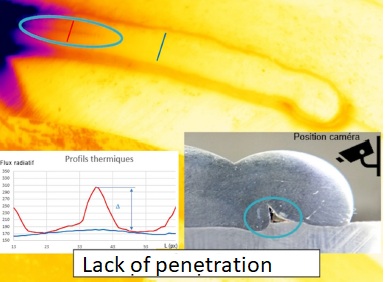
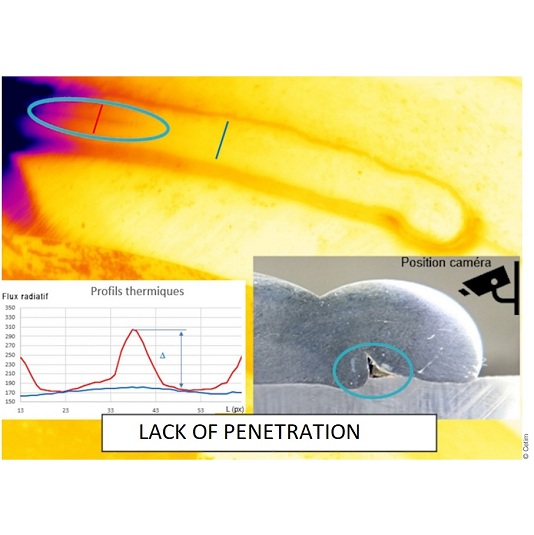
Identification of lack of penetration between two overlay welding passes
using the TIG welding process, Inconel on carbon steel.
Toward Automated and Predictive Quality Control
These developments open major perspectives for industrial manufacturing:
- automated defect detection with predefined thresholds,
- real-time process interruption or alerting,
- finer characterization of defect size and depth,
- improved robustness and ergonomics of embedded sensors,
- and predictive models linking welding parameters to quality outcomes.
In the long term, real-time monitoring could significantly reduce, if not eliminate, post-process inspections, enabling smarter production lines where weld quality is ensured from the very first bead.