
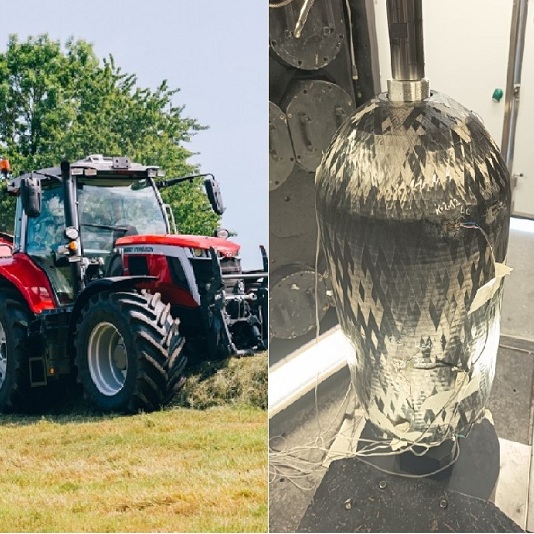
As part of the Arhystote* project, Cetim has demonstrated a pressure resistance of 1,675 bar on a thermoplastic composite tank designed for hydrogen storage.
This represents a major milestone in the development of Type IV.5 thermoplastic composite tanks. Within the Arhystote project – funded by the French government under the France 2030 programme and operated by ADEME, The French Agency for Ecological Transition – Cetim has successfully demonstrated a pressure resistance of 1,675 bar on a 62-litre tank weighing a total of 43 kg.
At the heart of Cetim’s R&D strategy on composites, these tanks are attracting strong interest from industry players due to their key advantages:
- a tougher thermoplastic material, offering greater damage tolerance and paving the way for extended service life and safer failure modes
- opportunities for innovative architectures combining multiple manufacturing processes to reduce composite weight and increase production rates
- the ability to weld the composite to its liner, reducing decontamination time
- and the potential to recycle the tank at end of life
Manufactured at the Technocampus Composites site based near Nantes in France, using the HySpide TP laser-assisted tape winding process, these tanks comply with regulatory requirements for 700 bar operation. They represent a world-first demonstration for this technology at such a combined level of pressure, volume and thermoplastic composite efficiency.
This achievement translates into a gravimetric index (ratio of stored hydrogen mass to total system mass) of 5.7% for the 62-litre tank, with projections reaching 6.8% for a 120-litre version. It highlights the R&D work carried out in recent years, contributing to the maturation of the entire development chain, from characterization methods and design tools such as the Optitank solution developed by Cetim, to the optimization and reliability of manufacturing processes (heating, consolidation, laydown speed, trajectory).
This highly encouraging result paves the way for further testing phases within the project. It also marks a key step toward the development of lighter, safer, recyclable, and industrially scalable hydrogen storage solutions, addressing the needs of heavy-duty mobility, aeronautics, space, as well as high-pressure hydrogen distribution and storage infrastructure.
Project partners: AGCO-SAS, RAIGI, IPC, OLIKROM, CETIM
*This project was funded by the French government under the France 2030 programme, operated by ADEME.