

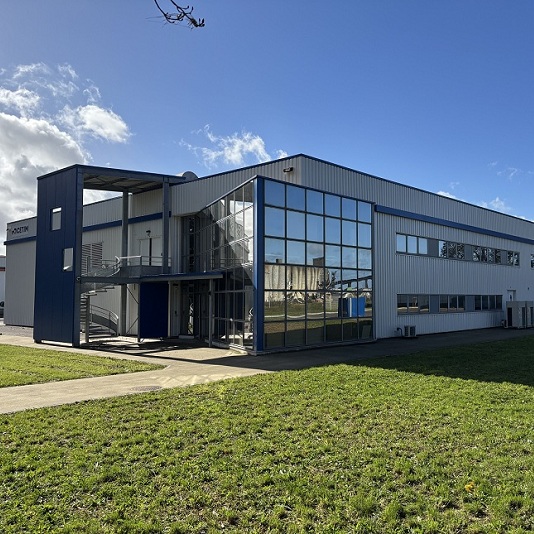
Hydrogen, LNG, CO₂, cryogenics: a unique platform combining state-of-the-art testing facilities and multidisciplinary expertise to qualify equipment, enhance reliability and accelerate the industrialisation of critical technologies for the energy transition.
Storing liquid hydrogen at -253°C, transporting pressurised CO₂, or ensuring the leak-tightness of equipment exposed to highly diffusive gases such as hydrogen: the emerging energy sectors are creating major mechanical challenges. To address them, Cetim has commissioned a new 1,800 m² technological platform dedicated to harsh environments at its Cheviré site near Nantes, in France.
The platform brings together advanced testing, characterisation and qualification capabilities, drawing on Cetim’s multidisciplinary expertise. It enables manufacturers to reproduce representative operating conditions, understand the phenomena likely to affect their equipment, improve reliability and secure the transition to industrial deployment.
Understanding and controlling the effects of harsh environments
Gaseous or liquid hydrogen, LNG, methane, captured and stored CO₂, as well as cryogenic applications, subject materials and equipment to particularly demanding combined stresses. Corrosion, gas diffusion through materials, embrittlement at very low temperatures, fatigue, ageing, changes in tribological behaviour and loss of leak-tightness can all affect equipment performance, structural integrity and service life.
Understanding and controlling these phenomena is essential to securing design choices prior to industrial deployment. This requires not only facilities capable of reproducing such environments, but also the expertise to interpret the results and translate them into informed technological decisions.
From understanding phenomena to qualification
The strength of this new platform lies in its combination of dedicated experimental facilities and complementary expertise that can be mobilised around a single industrial challenge. It addresses the need to assess the behaviour of critical equipment such as pressure vessels and piping systems, valves, sealing systems, sensors and other key components, whether specifically developed for emerging energy applications or operated under new service conditions.
The platform provides testing capabilities under hydrogen, methane and CO₂, including deep cryogenic and high-pressure conditions, to characterise mechanical behaviour, permeation and ageing mechanisms, corrosion, embrittlement, rapid gas decompression and sealing performance, from materials through to complete systems. Testing capabilities cover temperatures from -253°C to +450°C and pressures of up to 1,000 bar.
Developed in part through Cetim’s HyMEET project, these facilities are supported by the Centre’s multidisciplinary expertise in design, simulation, testing engineering, instrumentation, manufacturing processes, joining technologies, non-destructive testing, equipment integrity monitoring and failure analysis.
More than a testing centre, Cetim’s technological platform dedicated to harsh environments bridges the gap between the observation of physical phenomena and industrial decision-making, helping manufacturers optimise material selection, design, manufacturing processes and qualification strategies.
Expertise already supporting industry
For more than twenty years, Cetim’s teams have worked on issues related to gases and harsh environments, initially serving industries such as Oil & Gas, nuclear energy and aerospace. This long-standing expertise has naturally been extended to support emerging energy sectors, while continuing to develop dedicated methods and facilities.
These capabilities are currently deployed in numerous European and national collaborative programmes, supporting both applied research and demonstrator development, as well as more fundamental research aimed at overcoming technological barriers, particularly through several doctoral research projects.
Supporting the industrialisation of decarbonisation solutions
New energy carriers, carbon capture, transportation and storage are creating new mechanical and technological challenges for industrial equipment. Building on decades of experience gained alongside leading industrial players, Cetim supports this transition through a combination of testing capabilities, engineering expertise, technology watch, standardisation activities and training.
This comprehensive approach enables manufacturers to anticipate technological and regulatory developments while acquiring the knowledge and skills required to successfully industrialise these emerging solutions.
The platform at a glance
- More than 1,800 m² dedicated to harsh environments
- 4 K (approximately -269°C) minimum temperature capability, using a helium-hydrogen liquefier and cryostat
- -253°C to +450°C and up to 400 bar: environmental mechanical testing machines
- Up to 1,000 bar under hydrogen, with decompression rates up to 70 bar/min
- 2,000 kN press capacity and associated installation, up to 600 bar
- Hydrogen leak detection sensitivity down to 10⁻⁷ Pa·m³/s
- Applications: gaseous and liquid hydrogen, LNG, methane, CO₂ and cryogenic environments; ammonia and H₂S through dedicated partnerships
Meet Cetim at two major upcoming events dedicated to Hydrogen:
Hydrogen & CCUS World Expo
Stand 7G65, Hall B7
20-22 October, Hamburg, Germany
Hyvolution 2027
19-21 January 2027
Paris Expo Porte de Versailles, France