

Mastering aging to enhance the reliability of your products.
Accelerated Weathering Tests:Artificial Ageing
Your expectations
In today’s industrial context, where products are exposed to increasingly demanding environments, mastering material ageing has become a strategic imperative. For manufacturers, it is essential to guarantee product durability, reliability, and regulatory compliance throughout the whole lifecycle. To secure material choices, accelerate developments, and validate specifications, industry needs tools capable of predicting how products behave over time. Because natural exposure testing is lengthy and difficult to control, accelerated artificial ageing has become a key solution. It enables the reproduction of severe yet realistic conditions, the comparison of formulations, and the robust qualification of materials.
This translates into the need to:
- Know or estimate the resistance of your materials and products to solar radiation, for control, validation, or expert appraisal;
- Reproduce in the laboratory severe but realistic exposure conditions (UV, temperature, humidity, rain/condensation);
- Perform tests that comply with your sector’s references (plastics, coatings, textiles, automotive, building, etc.);
- Benefit from controlled, repeatable accelerated artificial ageing tests, including the monitoring and interpretation of key parameters (appearance, mechanical and physico‑chemical properties).
Our solutions
Artificial ageing does not reproduce every interaction found in natural exposure, but it enables controlled variables and a repeatable, controlled acceleration of material or product degradation mechanisms.
Our accelerated weathering tests rely on xenon‑arc chambers, standardized protocols, and comprehensive visual, mechanical, and physico‑chemical evaluations:
- Platform of xenon‑arc environmental test chambers (full solar spectrum UV + visible + IR) for "outdoor daylight" or "behind‑glass" exposures, with control of temperature, humidity, and water (spray/condensation);
- Standardized or tailor‑made test programmes;
- Visual (light booth, colorimetry, gloss), mechanical (adhesion, tensile, flexural, impact), and physico‑chemical evaluations (tracking degradation) with associated interpretation;
- Possibility to conduct long‑term comparative studies, natural weathering vs. accelerated artificial weathering.
Standards and References Covered (examples)
Test types |
Common standards |
Lightfastness / UV exposure |
NF EN ISO 4892-2; NF EN ISO 16474-2; NF EN ISO 105-B02 |
Environmental tests |
NF T 30-049; NF EN 60068-2-5; MIL-STD-810G Method 505.5 |
Cyclic tests |
NF EN ISO 11997-2; NF EN ISO 20340 |
Automotive tests |
PSA/RENAULT: D47 1431, D47 1122; NISSAN: NES M0135, NES M0141; VW: PV 3929, PV 1303; FIAT: 50451, 50451/01, 50471/01; TOYOTA: TSM502G |
Our Facilities
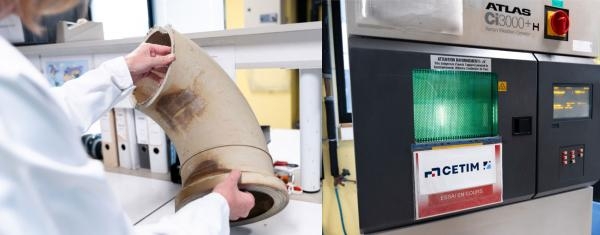
Xenon‑arc chambers faithfully reproducing natural sunlight, with precise control of UV, temperature, humidity, and water.
Your benefits
You get:
- Precise, reproducible, and repeatable results: plastics, composites, elastomers, coatings, and textiles exposed to UV (outdoor or behind glass).
- Shorter lead times than natural exposures, with test cycles representative of end‑use conditions.
Proven Track Record & One‑Stop Service
Since 2014, we have conducted UV ageing tests in xenon‑arc chambers reproducing the solar spectrum, in line with key standards (ISO 4892‑2 / 16474‑2 / 105‑B02, MIL‑STD‑810, etc.), delivering precise and repeatable results.
Over 200 clients have placed their trust in us, across applications ranging from polymers and composites to paints and coatings.
We provide a one‑stop service that links UV exposure with mechanical and physico‑chemical characterizations, as well as standardized visual assessments (grey scale, gloss, colorimetry), to accelerate and de‑risk your qualifications.
Documentation
Accelerated Weathering Tests:Artificial Ageing