The case
EDF aims to optimize the maintenance of composite structures in its operating fleet that are subjected to long-term mechanical stresses. Some areas of these structures are not instrumented, which means their condition must be assessed through visual inspections, whose interpretation may vary depending on the expert. “The need to decide whether or not to intervene quickly has an impact on profitability. We needed to develop a tool to make maintenance decisions for our fleet more objective”, explains Salma Belouah, Project Manager at EDF R&D.
To build a digital model capable of simulating the mechanical behaviour of composite beams in the event of impact, cracking or erosion, EDF R&D first needed reliable data on their composition and properties. A five-meter section recovered from one of the fleet’s structures served as the basis for the characterization campaign.
A structured and iterative testing program
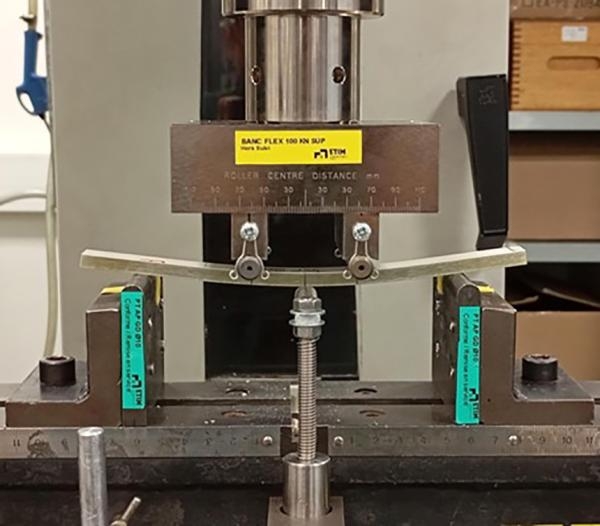
Cetim supported EDF R&D in defining a bespoke iterative approach: identifying the relevant cutting areas, performing X-ray tomography to analyze the internal architecture and fiber orientation, sampling and machining test specimens, and carrying out physicochemical and mechanical tests. The resulting data (geometries, properties, dimensional measurements, etc.) were then used to feed the modelling work and create a digital twin. In a second phase, a finite element calculation approach incorporated the experimental constraints.
“The tests were not standardized. Cetim had to move forward iteratively and demonstrated a strong ability to make proposals throughout the project”, says Salma Belouah. The collaboration with Cetim is continuing through new stages of the project.