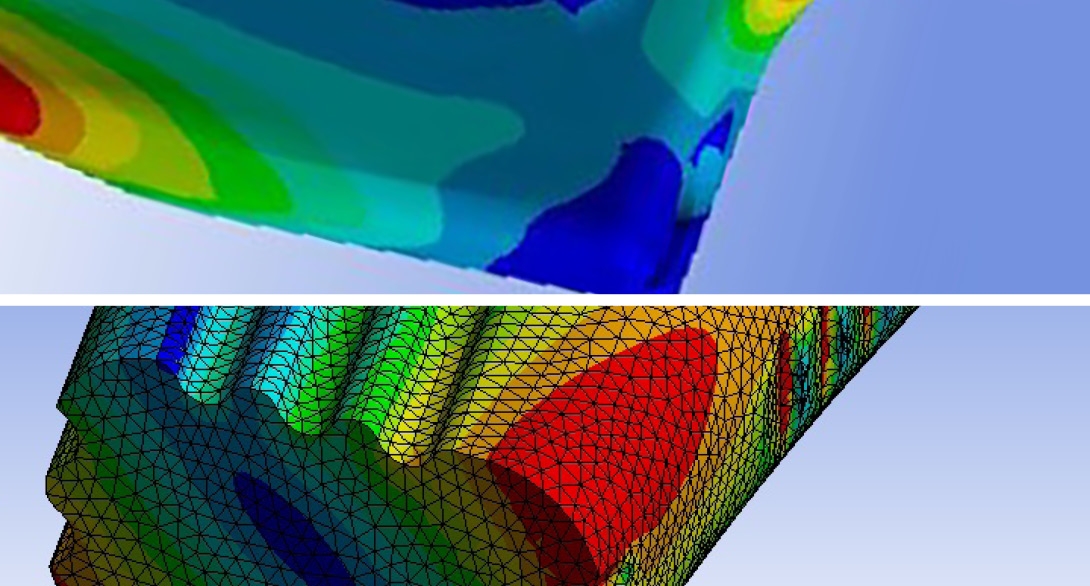
In general, creating a new product involves many tests and prototypes in order to verify the validity of the design, guarantee compliance with standards and determine product reliability. To save time and lower the development costs for its new hip implant models, senior managers of Corin Group asked Cetim’s experts to digitally confirm the shape of the hip implant stems with regard to the requirements of standard ASTM F2996-13 and existing products.
Stress mapping
Five femora stem designs were virtually analysed and categorised by order of resistance with a mapping of the specific stresses for each model. “In relation to the new products under development, we wanted to check, by calculation, that our new hip implant designs, featuring longer and wider stems and different femoral neck inclinations, fall within the criteria laid down in Standard ASTM F2996-13,” explained Eric Renault, head of R&D at Corin Group. The fatigue calculations also took into consideration the product surface irregularities, particularly the notching carried out to achieve good osseointegration of the implants in patients.
Time and cost savings of over 50%
Therefore, Cetim tasked its teams specialised in fatigue calculations, biomechanics and simulation with integrating and handling the customer’s CAD files and materials. “The numerical tests carried out using Solidworks and Ansys helped us to validate the reliability of our new designs in one and a half months and saved us valuable time compared with conventional prototype creation methods,” stated Eric Renault. “We saved 50% of our development time and reduced our costs by 60%”.